

Black Tea and Oranges
Setting out alone through broken country, I began to shed more than possessions.

This essay forms part of an unfolding book I’m drafting here on Substack, under the working title Walking with Poetry in Mind.
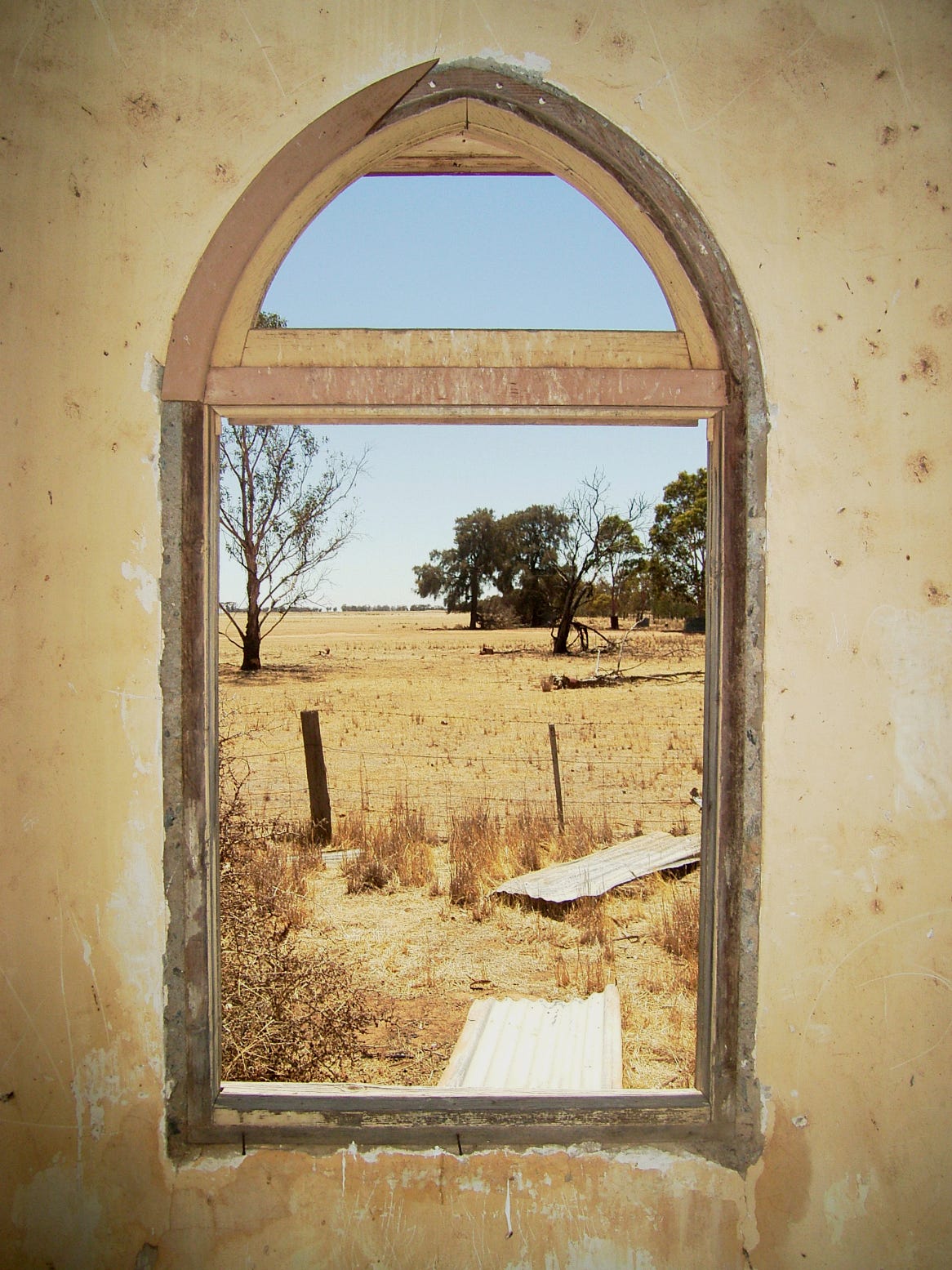
Black Tea and Oranges
I rode through broken country. Past abandoned churches and old ruined houses that had somehow escaped destruction during the Great Depression, when, I once learned, farmers would sometimes burn empty old houses so they would not be taken over by vagrants. Now I was a kind of vagrant myself, but I did not need a house.
Farmers passed in white utes, symbols of order, striving, suspicion. Thoughts ran through my mind, pretending I knew what they were thinking: What is this crazy bastard doing riding his bike past my farm? Some properties were immaculate, cut into obedience. Perfect fences. Others were run down in ways that suggested a man living alone had long since given up on everything except his sheep and his dogs.
By the roadside I kept seeing trees marked with crosses and names: Gary, Peter, Mick. Sometimes there were faded photographs, plastic flowers, cans of bourbon left in old football club can coolers. I rode past hundreds of these memorials on that journey. I had never really entered this world of sadness before, only passed through it. Out there, in country where even the birds seemed to go scarce, the roads felt like crossroads of a crisis I did not yet understand.
One of the rituals I made for myself in that world was tea. I would pull up at a crossroad in the middle of those plains, with fence lines running straight off into the distance, grey box trees behind me, and broken grey sticks and old bones underfoot. Noisy miners worried the canopy, chasing other birds like some battle going on in a brain. I would sit on the ground, or on a log, or at a picnic table in a small-town park, unpack my cooker and small aluminium kettle, and light the methylated spirits. Then I would sit quietly and wait for the water to boil: one black tea bag, one teaspoon of sugar, my blue plastic thermos cup ready. Then I would sip slowly, maybe with a biscuit and some cheese, or an orange. Black tea and oranges went so beautifully together during those bright days.
A cup of tea
alone at the crossroad.
Still only tea.
And on those days I felt no urge to write, and very little urge to talk to anyone. I had brought a journal, but after about four days of pain I offloaded it to save weight. I got rid of my telescopic fishing rod and tackle, a book or two, and an extra pot I didn’t need. If I had set out with few possessions, I carried even fewer as the journey went on. I finished Steinbeck, then found Doctor Zhivago in a thrift shop. Later there was a second-hand copy of Zorba the Greek. Those books became other worlds travelling beside me. I was never lonely with such characters around.
And as the days went by, and as I rode towards the mountains of north-east Victoria, I became simpler too. I was shedding not only kilograms but possessions. I was becoming a rider and nothing else. No longer a son, or a brother, or a man who had been left, or a worker with a role to play. Just a body moving through weather, in sunshine and sleeping under stars, following the road north, then west.

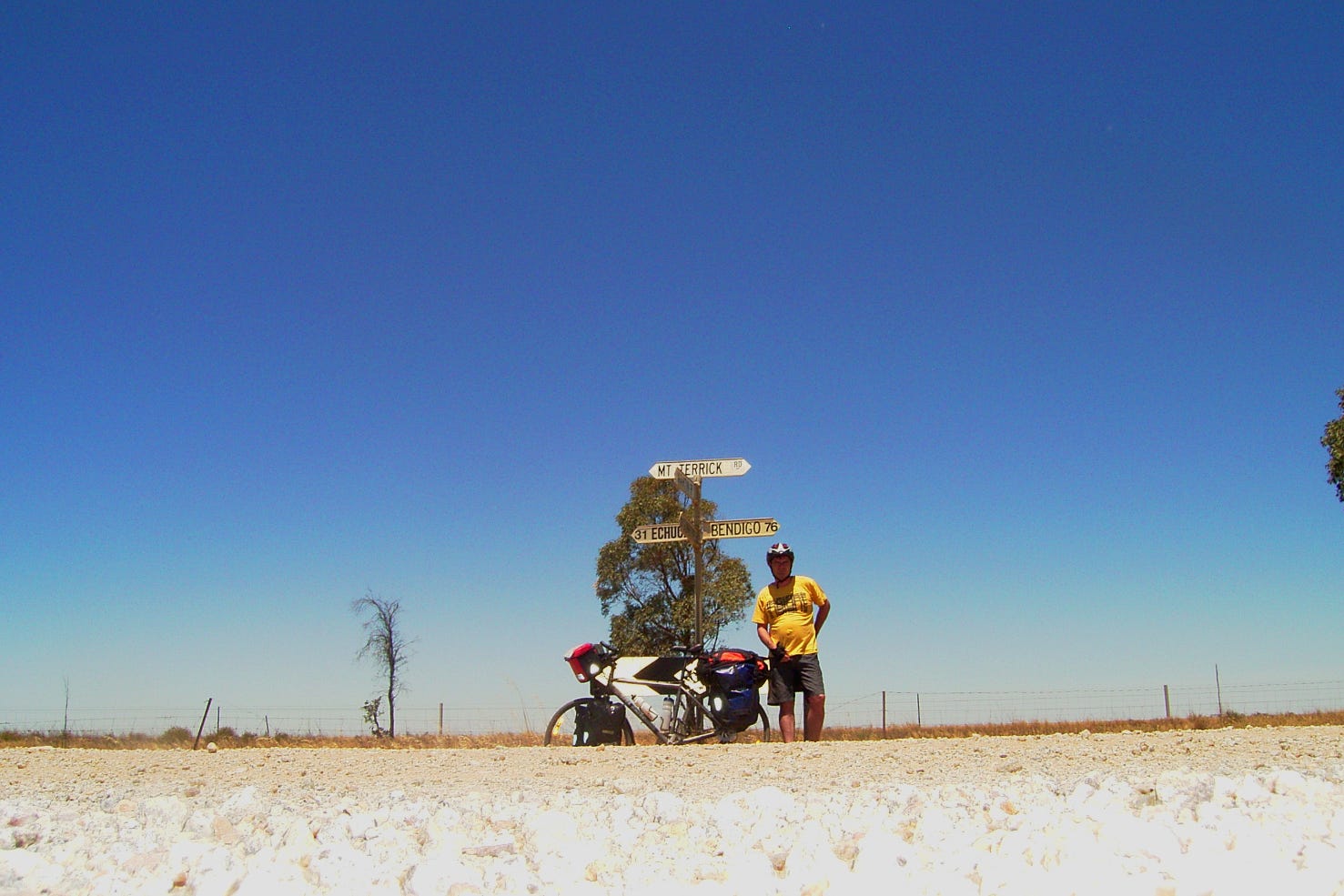
There are moments when life becomes very small again.
A road.
A cup of tea.
A body moving through weather.
And strangely, nothing feels missing there.
Walking with poetry in mind is a strong working title.