

Raku
For Robert (Bob) Powter - who made and taught pottery

I grew up in a part of the goldfields here in Victoria called Adelaide Lead. For a brief period of time in the 1850’s it had thousands of people from all over the world living there looking for gold and eking out a living in other ways. By the time I lived there, from the mid-1970s to the late 1980s, about a hundred people remained in the locality.
There was a large field behind my house, and in the far corner next to the creek were large white mullock heaps where small teams of miners long ago had dug fairly deep shafts to get down to the gold-bearing alluvium — the gold-bearing gravel buried millions of years ago by ancient rivers and cataclysmic events. The various strata the miners dug through also consisted of what they called pipe clay, a white clay that was sometimes suitable for making all kinds of objects.
Also in the field behind my house, a few hundred metres away, was evidence of a potter who used to supply ceramic wares to the local region. The only evidence of his house and sheds, when I used go there exploring, were old bricks, tangled pieces of iron and wire, and shards of broken pots often glazed with a green or brown metallic sheen. For me as a kid who grew up reading about digs in the Valley of the Kings or on some Greek island searching for Atlantis, it was a fascinating place, even though there wasn’t much there anymore and, when there wasn’t an oats crop, it usually was just an empty paddock with a few sheep.
Many years later, the subject of the old potter’s ruins and the pipe clay heaps came up again. I was just starting to get to know the eighty-year-old man who lived across the road from me. He and his wife kept to themselves mostly, and he had been fairly ill with a heart condition over the previous few years. But with the help of my other neighbour, I was just beginning to get to know Bob.
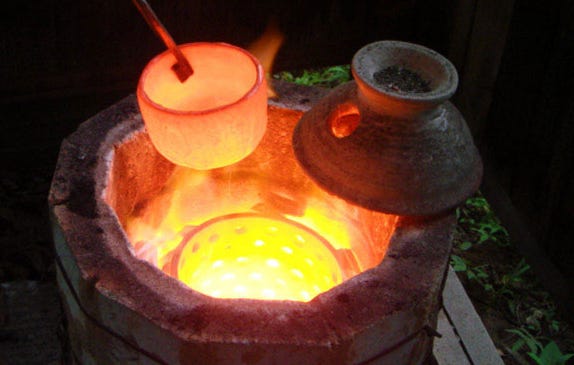
I learned he was a fairly well-known ceramic artist, specialising in traditional Japanese pottery. He was renowned for his knowledge of tea ceremony ware, especially the various types of matte black and brown glazes produced by the Raku style of firing pottery. Bob had taught in many different places and had visited Japan many times in the name of his art.
So when I told him about a potter from more than a century ago who used the local clays to produce clayware, he was very curious and wanted me to go over to the field and find him some of the shards with different coloured glazes. Sadly, I never did get over there to find him any of this treasure. He died in his sleep one night not long after our conversation. Perhaps I will go back there soon and try to find a pot to put back together. He also lent me a small notebook of haiku poetry that he had copied out by hand, I think he’d translated the Bashō poems from Japanese himself. I gave the book back to his family after he died. It was a beautiful thing to read, though, in its simplicity: just a small basic notebook, each page with a different haiku poem.
That loan of his notebook—that recognition of me as a poet—is what this poem tries to honour.
Raku
I.

He lived across the road,
reclusive, nearly eighty,
his heart slowly giving way—
still pouring good scotch,
still searching for conversation
through cigarette smoke
with potter's hands.

A ceramicist, I was told,
lecturer, maker
of Japanese bowls and tea rituals,
Raku, mostly.

After he learned I was writing poems
he brought out a small book—
Bashō copied carefully
in his own hand—
and placed it in mine
as if passing a cup
still warm with tea.

Not long after,
he was gone.

⸻

II.

He embraced my imperfections.
I told him I could find poetry
in broken faces.

"Our lives are fast-fired," he said.
"We never know how they'll turn out."

He was nearly ash himself,
yet his centre held a radiance,
ready to be lifted
from the kiln.

"Poetry is combustible material," he said.
"It is where the bowl goes
after it is born."

"Then poems are life," I said.

"No," he said,
"you've got it backwards.
Life is what shapes us."

"We are shaped?" I asked.

"By love," he said,
"and enjoyment—
Raku."

I knew when he was gone
our haiku friendship:
just beginning,
ending perfectly.
Lovely story and poetry
I feel you honoured the 'well-known ceramic artist' very well, Damian. 🗝☕🕰📜🎞🖋️