

Freshwater
Twelve poems shaped by creek and river

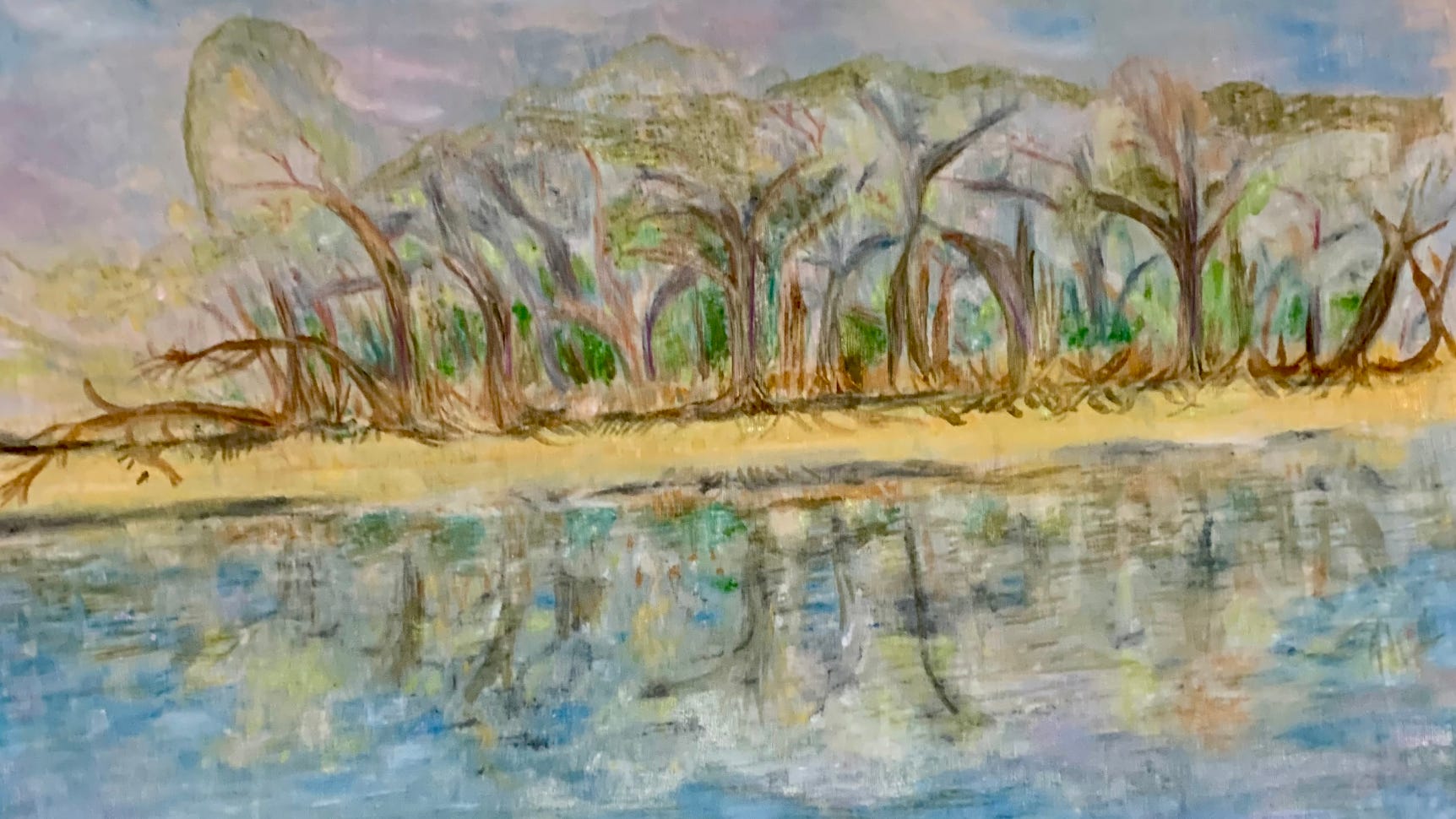
It’s raining here today for the first time in months, steady quiet rain on the roof, water finding its way back into the gutters.
By morning the creeks will be running again.
Here are twelve of my poems shaped by creek and river.
The posts that each poem appeared are linked to each poem’s title.
Enjoy…
Damian
Water
Above us,
the land stretches away
like a tired horse,
ploughed to death nearly.

Here and there,
a few trees remain.
Or did they walk here?
Did they come to the water?

In the shallows,
we sit watching dragonflies hunt,
galahs perched on a fallen tree,
feathers pink against the dry grey bark.

We smile to our hearts,
hearing the kids laughing across the way.
"Sound carries," you say.

I watch you with clear eyes—
no distance between us now.
We feel everything shifting,
subtle and certain,
as light shimmers on the water,
as dry spirits move the leaves.

We curl our toes in the mud, defiant,
and your kiss wakes me up.
Suddenly, tomorrow matters,
and our touch is warm,
hidden beneath the surface.

Though we both shiver with strange emotion,
I do not question it—
just look into your dark eyes
until I am distracted—

a woodswallow, diving from high,
catching insects in the blue,
the sky over your shoulder alive with motion.
The birds are like jewels in your aura,
which nothing—not even me—
can separate today.
Green Dream
A small blue dragonfly,
a golden afternoon sigh,
capturing the blue morning
in the iridescent flash of wings
which never seem to stop.

It hovers past my breath
over uneven grass,
waiting for the ponderous eye—
a gaze filled with green dream.

The dream was of a giant fig tree
clutching the side of a mountain,
its roots drinking the memory
of a volcano long gone cold,
fed by an ancient spring
where wild roses bloom like stars.

She waded in,
the creek’s dark glass shivering.
She wondered where everything came from—
until, diving into the cold black water,
she remembered.
What the River Knows
In the Stream
Between boulders,
I watch you sit on your rock,

warm, satisfied
with being and knowing.

This place,
this time—
with a man still a stranger,
like everything here.

He knows patience—
can sit in sooty water,
let the current wear him smooth.

The river carries voices—
old names, old longing,
where fading gods last drank,
cupped hands turned to stone.

We could touch,
but we are already touching—
the same beauty.

We could reach for each other,
but feel instead
the warmth of a day together,
fertile with unspoken dreams.

I let doubts slip from my skin.
You breathe out yesterday.

A breeze moves through—
cooling, alive,
as if stirred by a shadow
of some long-forgotten presence.

We lie in the grass,
becoming landscape,
as the stream sings
its old song.
Edith
The wind sweeps across the dry grass.
Faster than the cloud shadows.

I stand alone, watching.

Crows gather around the old windmill.
Meeting again for the first time in ten years.

Hundreds of them.
Flying in from every direction.
For no reason I can tell—
except to be tossed in the wind,
to collide,
to tumble like dark acrobats.

It has been a long time since I have seen the brolgas dance.

I used to sit for days, lost in their dance.
Then the farmers came.

Drained the overflow.
Shot the birds.
Built rabbit-proof fences.

Now, only the rabbits remain.
My quiet companions in the rocks and holes,
where I have slept for years.

Woken only by rain.
Or the cries of fox cubs fighting in the dust.

I sleep in the cliff high above the house where I once lived.

From here, I can see my own grave.
A small valley below.

The gravestone is gone.
Swallowed by wild roses.

They never put up much for me.
Just a slab of red gum plank.

Edith.

The only sister of the man who carried so many rocks,
hammered so many stones,
that he turned into a rock himself.

I do not remember much about my home.
Only that it looks much the same.

The roof has vanished.
The walls are crumbling.
Plaster lost in the rubble.

The water tank has collapsed.
Rusting.
Caved in on itself.

Everything has rotted away.

Sometimes, on stormy nights,
I try to push down what remains.

When my sorrow makes me believe
I can still touch the world.

I throw myself against the walls with the wind.
But nothing moves.

I feel only a numbness.

The same numbness my body once felt
on the coldest nights,
when the blankets slipped away.

And I did not care.

Yet I died burning.

I died in that house,
on a cold summer’s night,
when the wind howled through every crack,
trying to reach me like a ghost.

And now I am the ghost.

Am I a ghost?
Or only a shadow—
something my body left behind.

I live in the shadows.
I do not like the light.

Except where it glimmers
off the water of the creek.

When I stand in the creek,
I can feel it.

It is the only thing I can feel.

But when I leave the water,
I become no more than dust again.
No more than a whirlwind in the paddock.

Lost.

Directionless.

Until I wake once more in my hollow.
Staring up at the sky.

At the cold light of the distant moon.

My grave lies beneath the wild roses.
On the other side of the fence.

Near the poplars,
clinging to the cliff face,
where the volcano’s side once fell away.

I do not remember how I died.

There are only moments.
Only pieces.

Bright, hot, windless days,
when the crows fly effortlessly.

Drifting wherever they please
over the mountain.

It was on such a day
that I last saw my body.

I remember looking down.
Seeing myself.

Still.

At peace.

By the next morning,
I could not bear to look again.

My body had already begun to return to the earth.

Taking on the hollow stillness of the sheep,
the cattle,
the ones that had perished in the fields.

I was killed by the drought.

The neighboring farms had lost all water.
My brother, generous,
allowed them to bring their cattle down to our creek.

But generosity breeds resentment.

Soon, there were fights.

The cattlemen would not leave the valley.
The land could not sustain us all.

And so we fought.

Fought over feed.
Over water.

Fought over the question of running water.

And who, in the end,
could ever claim to own the land.
The Night Swimmer
He was asleep on the couch.
She was glad, in a way—she wanted to be alone.

They had watched TV for a while.
He had kept going to the fridge, again and again,
and now, whatever he had been trying to forget—he had forgotten.

It was still a mystery to her why he was the way he was.
Compassion still shone in her heart for him,
but his drinking, his talking,
made her feel lonely.

She stepped outside into the cool, still air,
beneath the starlit sky.

Out here on the farm, fifteen minutes from the nearest town,
millions of stars twinkled,
each vying for her attention.
She didn’t look at them for long.

A lot had been on her mind.

Yesterday had been a warm autumn day.
She had walked with her daughters down to the river.
Though she had been living here for a year,
she had never crossed the paddocks to the water.

She had expected a dry, gravelly riverbed,
but instead, she found a billabong,
surrounded by towering red gums.
Deep pools lay still beneath their branches,
edged by rushes.

They had sat for hours on a big, fallen log,
dangling their toes in the water,
talking about nothing in particular.
Watching the ripples shift and reform.

Megan had said she wanted to dress
the same color as the birds—purple and black.
Her older sister told her that would suit her,
since she already looked like a duck.
They had all laughed.

And now—here their mother was, walking alone.

It wasn’t unusual for her to walk at night.
Most nights, she wandered to the old, fallen-down house
behind the sheds.

She would sit on the well next to the peppercorn tree,
watching the stars.

But tonight, she walked west,
down the driveway toward the road.

In the paddock beside her,
the black bull—the one the kids fed carrots—
watched her silently pass.

Across the road, in the distance,
embers from a stubble fire still glowed.
She wondered if it could start a grass fire.

They hadn’t had rain in what felt like years.
But tonight—there was no wind,
and whatever was burning seemed small.

She climbed through the fence with ease.
She had always been good at getting through fences,
though she bore scars
where barbed wire had once made things difficult.

Now she was a long way from the house—
far enough from the road
that no one driving past could see her.

It was about two kilometres to the river.
Tonight, the trees that grew there
were bathed in a soft yellow hue.

A brilliant moon was rising over the hills behind her,
and the trees were catching its light.

The further she walked from the house,
the freer she felt.

She began to daydream, though it was night.

She thought of a fish-and-chip shop in her old hometown,
of sitting inside, watching her brother play pinball,
scraping her thongs against the linoleum floor.

He had turned and told her off.
She had taken them off, stepped outside barefoot.

The footpath had still been warm.
She perched on a windowsill,
watching Torana and Kingswood cars pass by.

Men in black T-shirts, tattooed arms
hanging out of car windows.

She had wondered then—
did their cigarettes burn faster in the wind?

And now, tonight,
that old stump in the distance
still burned in the same wind.

She made her way down into the gully,
stepping carefully to avoid Scotch thistles and cow patties.

The billabong was noisy in the darkness.
Pobblebonk frogs bonked.
Froglets creaked.
A black duck made itself known.

On the fallen log, she crept to the end,
stretching herself by holding onto a branch.

The water was black,
moving as insects broke the surface
or fell onto it from some unseen height in the canopy.

She sat on the crumbling bark,
slapping at mosquitoes.
Humming a tune.
Feeling the smoothness of her legs.

Good for running, she thought.
Good for jumping fences.

She took off her shoes,
moved back along the log
to where her feet could dangle in the water.

It was warm and pleasant.
She did not feel sleepy.
Did not feel guilty for being so far from home.

She felt at home here—
by herself, under the stars.

She had not been skinny-dipping in years.
Not since that day with her best friend,
when they had gone looking for marijuana plants
along a secret creek in a secret place.

She remembered how the water had felt then—
magical, washing away her hangover,
restoring her soul.

She had trusted him.
And he had been happy just to exist in the same galaxy as her.

Her naked body had not distracted him
from the beauty of the place.

But this was a different river.
And tonight, she was alone.

She would swim again—
not for any reason
but for the love of it.

Expecting strange things
to reach out and touch her feet,
she lowered herself into the dark water.

As her body slipped beneath the surface,
out of the moon’s sight,
she let out a slow sigh.

She swam to the center of the billabong,
then floated,
her head and ears submerged,
enjoying the silence.

She whispered to herself,
humming something she didn’t understand.

She ran her hands over her face,
down the front of her neck,
to her breasts.

Stopped at her nipples—
large now, hardened.

What would a baby’s mouth feel like on them again?

She ran her hands down to her belly.
To the place where life was growing.

She looked up at the stars.
And she thought—
maybe her baby was a star.

A star fallen from heaven.

Far off.
Far away.

Here alone,
she was not afraid of the future anymore.

Everything was simple.

Her heart swelled with happiness.

In the silence of the water,
her mind was silent too.

She did not think of herself as old.
She did not think of herself as young.

She simply felt powerful and alive.

Had her mother, thirty-five years ago,
gone somewhere alone like this?

Wondered about her body?

A wave of sadness touched her,
for the first time.

Then she turned over and swam.

Forgetting her sadness.

Searching for the sandbar at the end of the billabong.

She sat there, hands pressed into the cool sand,
aware of the moonshine
on the water
and on her skin.

Listening.

Alive.

And cold now.

And now.
Tickling Eels
You laughed
as I lifted up the dark, beautiful thing
and threw it on the bank.
Bewitched as it danced,
too slow to jump on it or hug it,
it escaped through the tangle—
that beautiful black eel in the night,
alive under moon and stars.
We settled back down,
chins on the crumbling edge,
arms in the water,
hands in the mud,
waiting for the moment,
waiting a million years,
in a child's mind.
You sighed,
“we’ll be here all night.”
“be patient,” I said.
The rabbits rustled,
the fox listened,
the stars shimmered,
our faces—dark faerie reflections.
Our father could be heard, coming down the hill,
a ghost from Loch Neagh
to call us in.
But we were lost in the night,
tickling eels in the creek,
knowing nothing of what the old ones knew.
“Call us in.”
Galaxiid
Sunlight on rising
and falling water,
we feel for fish together—

dark shapes racing
to the bed
where they hide forever.

Fragments of never
seen again,
extinct as our touch,

our fingers to our faces
slipping through,
smoothness escaping hands.

Alone, we search
for Galaxiids
in this hidden stream,

where the wild us once swam—
skin remembering water,
love holding us still.
Heathers’ Paddocks
The creek was in flood,
cows high near the fence line,
heads down—
knowing.

She is on her way
as the first stars shine,
feet cold
but clean now

from the green creek
where yellow flowers swim
beneath the surface—
flowing.

The cows walk down
at her creek-song call,
from the hollow,
thinking of the stove door
opening.

Soon she feels the steam
of their warm breath
as she touches their sides—
the gate
closing.

At the main road,
free from far-off headlights,
imagined horns
loud in the darkening.

Muddy lane beckoning,
and the milking shed
where her father hides
his last drink
smiling.
A Pilgrim’s Conversation at Puenta la Riena
Pilgrim
I walk today
past the place where Mary stood—
little bird, wash my eyes.

Bird
my wings flutter—
river light in your eyes
you see what you need

Pilgrim
Your kind water—
providence for my heart.
You hold me above the current.

Bird
I carry no words.
Only water, and the weight
of your not seeing.

Pilgrim
Then stay awhile,
teach me to return each day
with nothing but love.

Bird
no need for longing—
I come as the whole river
because you need nothing.
Mulloway Night
Gripping the outboard handle,
my friend pushes on, the boat hums
into the bend of the river
that beckons the night to show itself—
like an old story
of what heaven is really like
for fishers who fumbled
with nets in the moonlight,
their eel-oiled hands
shining in the dark.

Heeding these hunched men
hidden in our heavy bones,
we head downstream
beneath an ancient gum,
to that deep hole
where we caught the last black bream
on precious scrubworm
at the turning of the tide.

It had nearly taken his best rod
as he leaned forward
to chase a beer in the ice.
My swift hand took
the rod in a half a second—
ending the old fish’s fight
with the reflexes of a hundred generations
of whisky-breathed men,
fast in the clinch.

Yes, we sat at the end of the day
talking of mulloway,
waiting for the tide
to turn us toward the unrisen moon.
The artist in the dark—
rolls a joint,
but I was already gone
in the deep when the smoke is passed.

Later, under a million stars
that danced and shimmered
on the skin of the serpentine tail
of the life and light of the river—
we let the boat drift for an eternity
between being born and dying.

We were in the middle of the miracle,
and our lives had stopped for a moment,
our fingertips the only things seen—
glowing and warm.
We were lost in the swinging and the turning.
We were gone in the darkness.
Less than ghosts.

We left words unspoken
and only laughed
at not knowing our purpose or direction
in that beautiful moment—
not needing to know—
which is a rare thing for modern men,
who never get drunk with war or strife
or love or life,
who are kept in the light their whole lives,
until the far-off sound of sirens
takes them away
to a place
they cannot fathom.

We guessed our way back to the shore camp.
We could only ever get it half wrong—
the mountains or the sea.

Stoned with secret dark things
that shy from sober men—
in bunyip pools,
beneath the star-ripe branches
of yet unfallen trees
with storm-sculpted faces—
we fire up the outboard.

While our wild women
sleep in the branches above,
hair tangled in black twigs
and new green leaves,
watching us in their dreams,
then waking to wonder
where their screen-bright mates go
in their lunch breaks
of forever.
A Beautiful Thought
A beautiful thought
buried deep in your heart,
a seed under love.
Like Michelangelo's David,
it has always been within,
waiting to emerge.
It is the sky reflected in a lake,
and it is the buoyancy.
It is the wings in your mind
and it is you.
A temple on a mountain of many things,
buried under snow,
melting toward everything.

I want to play in creeks,
swim in lakes,
leap from mountains,
bury myself in sand,
immerse in the sea.

I want to be under things.
Under sky, under waves,
under dreams that pull me deep.
Cold Storage
cold storage—
we waited under the moon,
holding too much love
too deep beneath—
hesitating
to walk deeper

toward the valve tower
standing in the distance
like a desert tomb,

solitary,
with black cormorant sentinels
taking flight toward us,
their beating wings
just touching
the same surface

we have come here
to remember
where our edge is,

our eyes lifting
to the night—

deep water
where we've never been
Water moves through many of my poems. Sometimes as creek and river, flowing quietly through inland landscapes. Other times it reaches the edge of the continent, where land meets the sea.
A companion gathering of poems from the coast can be found in Shorelines.
Wonderful collection to return to again and again.
I love the line “suddenly, tomorrow matters”